
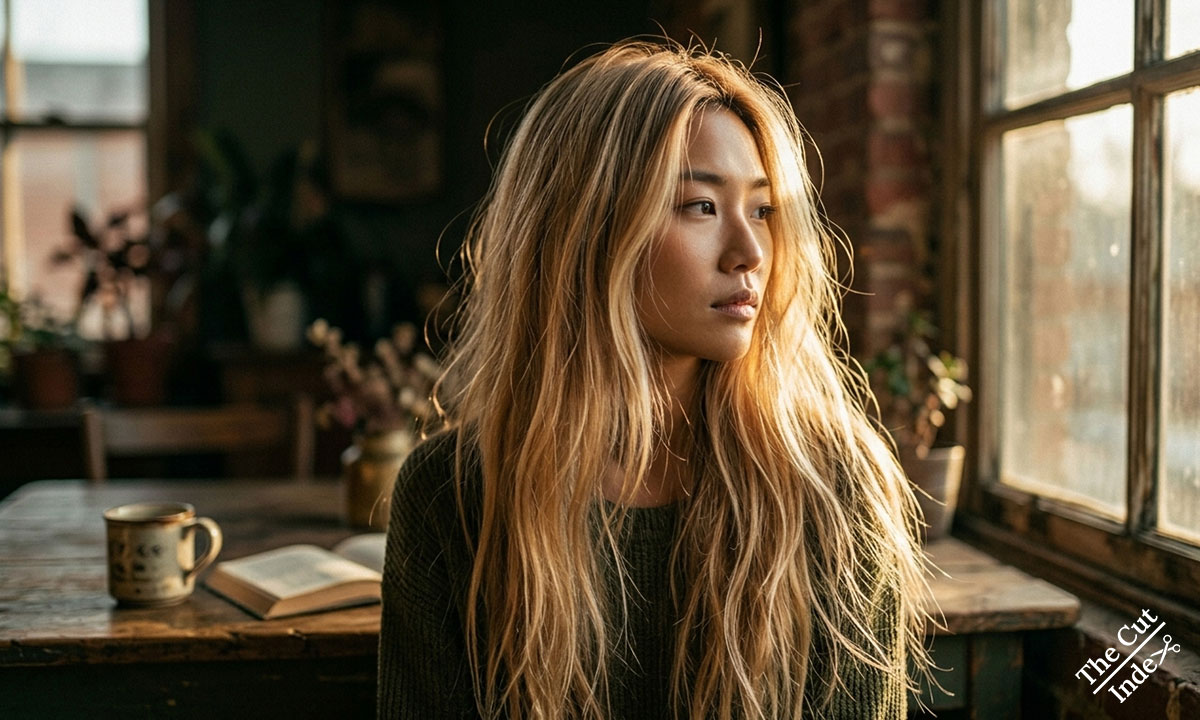
The biggest hair color trends 2026 has produced so far have one thing in common: they’re all softer than what came before them. Icy platinum lost the room to buttery blonde. Fire-engine cherry cola gave way to amber auburn. Flat brunette got dimensional. Even black moved from matte to glossy. Across every shade defining the year, the move is the same — from manicured to lived-in, from transformation to enhancement, from color to finish. Quieter, but not smaller. The work just relocated. It’s no longer the shade doing all the talking; it’s what sits on top of it. Glosses, color melts, glazes. The finish is the new headline.
1. Buttery Blonde
The warm replacement for icy platinum, and the headlining blonde of 2026. Buttery blonde leans soft gold and cream rather than ash or silver — the kind of blonde that looks like it caught a few weeks of sun rather than a salon appointment. Its real selling point isn’t the shade itself, it’s the grow-out. Roots come in without a hard line, which is why colorists keep recommending it to anyone tired of touch-ups every three weeks. Easier on the hair, easier on the calendar.
2. Honey Blonde
Honey is buttery’s richer sibling — deeper warmth, more saturation, more golden than cream. Colorists often build it using a base bump technique, where the underlying level is lifted before the warm tones are layered on, which is what gives it that lit-from-within quality on camera. It reads expensive without reading high-effort, which is the entire 2026 mood condensed into one shade. Pairs especially well with warm and neutral skin tones, and holds its color better than lighter blondes through summer.
3. Apricot Blonde
If cowgirl copper defined 2025 and felt like a lot, apricot blonde is the softened version that survived. It sits between blonde and copper — peachier than honey, blonder than auburn. The result is a warm-toned color that doesn’t demand the high-maintenance commitment of a true copper, while still adding enough warmth to shift a complexion. It works best on warm or olive undertones and tends to photograph beautifully in natural light, which is part of why it’s everywhere in feeds this spring.
4. Lush Truffle
The brunette equivalent of buttery blonde — sophisticated, warm, slightly glowy, with a faint red undertone that catches light rather than absorbing it. Lush truffle reads as the antidote to the cool ash brunettes that dominated 2024 and 2025. Where ash flattened the hair, truffle gives it depth. Where ash read clinical, truffle reads expensive. Colorists describe it as full of indulgent pigment, which is industry shorthand for: it looks like it cost more than it did. A semi-permanent application keeps it soft on the ends.
5. Dimensional Cocoa
A neutral, tonal brunette designed to give depth without darkness. The range runs from milk-chocolate cocoa to near-black coffee, but the defining quality is the dimension — soft tonal layering with no strong red or ash pulling at the edges. It’s the brunette most colorists describe as editorial but wearable, the one that requires touch-ups only every ten to fourteen weeks. For anyone who’s worn flat brunette for years and never thought of it as something that could move, this is the version that finally does.
6. Amber Auburn
The wearable evolution of cherry cola. Where cherry cola lived in fire-engine red territory, amber auburn pulls back into copper and clay — warm, earthy, still distinctly red but no longer shouting about it. It’s a key shade for anyone who flirted with red last year and wants to keep the warmth without the upkeep. Subtle copper highlights through the mid-lengths give it dimension; a gloss on top keeps it from going brassy. The most flattering red category of 2026, especially on warm undertones.
7. Cool Reds
The opposite shift from amber auburn — reds moving in the cooler direction. Burgundy, cherry, garnet, all leaning blue rather than orange. Where amber gives warmth, cool reds give drama: glossy, jewel-toned, slightly gothic in the right light. They suit cooler undertones the way amber suits warm ones. This is where the 2026 red category splits into two distinct lanes, and choosing between them mostly comes down to which way your natural undertone already pulls.
8. Velvety Black
True black, but with depth and gloss baked in. The 2026 version of black is built to catch light rather than read as a flat block — subtle layering through the lengths, a high-shine finish on top, and a velvety quality that gives the color movement. It’s the minimalist’s pick for the year, and the easiest commitment on this list, since black requires almost no maintenance compared to anything lifted. The trick is in the finish, not the color itself.
9. Grown-In Grey
The shift away from covering grey and toward enhancing it. Herringbone highlights — diagonal sweeps of warm and cool tones — melt regrowth into the natural base so grey reads as intentional dimension rather than a maintenance gap. The technique works on partial grey or full grey, and it’s the lowest-commitment color move on this list, because the grow-out is the point. The result is hair that looks the way grey looks in good lighting, all the time.
10. The Finish Layer Tying the Hair Color Trends 2026 Together
The technique that ties every color above together. Glosses, color melts, and glazes are the difference between a 2026 color and a 2025 one — they’re what creates the lit-from-within quality every shade on this list relies on. A gloss adds shine and tone without lifting; a color melt blends the line between root and length; a glaze refreshes pigment between full appointments. Even unaltered natural color benefits from a gloss every six to eight weeks. If you do one thing from this list, do this one.
Your Starter Shelf for the Hair Color Trends 2026
A few starting points, based on where you are now:
Growing out a platinum or icy blonde → buttery blonde with a warm gloss on top. Lets the roots fade in instead of fighting them.
Wearing flat brunette and ready for something → lush truffle or dimensional cocoa. Same level of maintenance, considerably more depth.
Loved cherry cola but found it too much → amber auburn. Same warmth, lower commitment.
Never colored your hair before → start with a gloss. It’s the finish layer of the year and the lowest-stakes entry point on this list.
Letting grey come in → ask about herringbone highlights. The technique is what makes grow-in look intentional.
The throughline holds across every entry: 2026 doesn’t ask you to commit louder, it asks you to commit better. The colors that define the year aren’t the brightest ones — they’re the ones that look like they were always meant to be there.
· · ·